

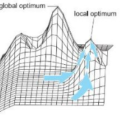
The Practimum-Optimum (P-O) algorithm represents a paradigm shift in developing automatic optimization products for complex real-life business problems such as large-scale manufacturing scheduling. It leverages deep business domain expertise to create a group of virtual human expert (VHE) agents with different "schools of thought" on how to create high-quality schedules. By computerizing them into algorithms, P-O generates many valid schedules at far higher speeds than human schedulers are capable of. Initially, these schedules can also be local optimum peaks far away from high-quality schedules. By submitting these schedules to a reinforced machine learning algorithm (RL), P-O learns the weaknesses and strengths of each VHE schedule, and accordingly derives reward and punishment changes in the Demand Set that will modify the relative priorities for time and resource allocation that jobs received in the prior iteration that led to the current state of the schedule. These cause the core logic of the VHE algorithms to explore, in the subsequent iteration, substantially different parts of the schedules universe and potentially find higher-quality schedules. Using the hill climbing analogy, this may be viewed as a big jump, shifting from a given local peak to a faraway promising start point equipped with knowledge embedded in the demand set for future iterations. This is a fundamental difference from most contemporary algorithms, which spend considerable time on local micro-steps restricted to the neighbourhoods of local peaks they visit. This difference enables a breakthrough in scale and performance for fully automatic manufacturing scheduling in complex organizations. The P-O algorithm is at the heart of Plataine Scheduler that, in one click, routinely schedules 30,000-50,000 tasks for real-life complex manufacturing operations.
翻译:暂无翻译




相关内容


 微信扫码咨询专知VIP会员