

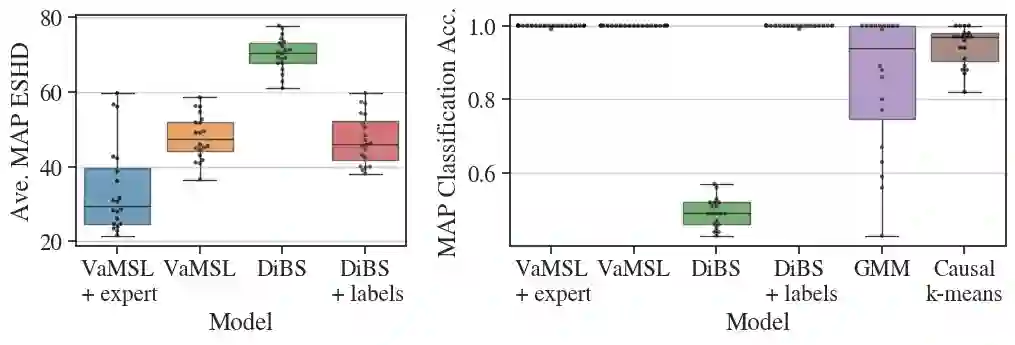
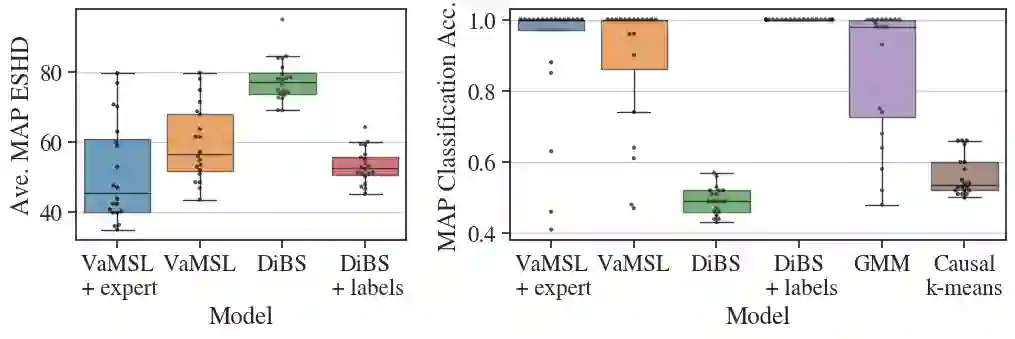
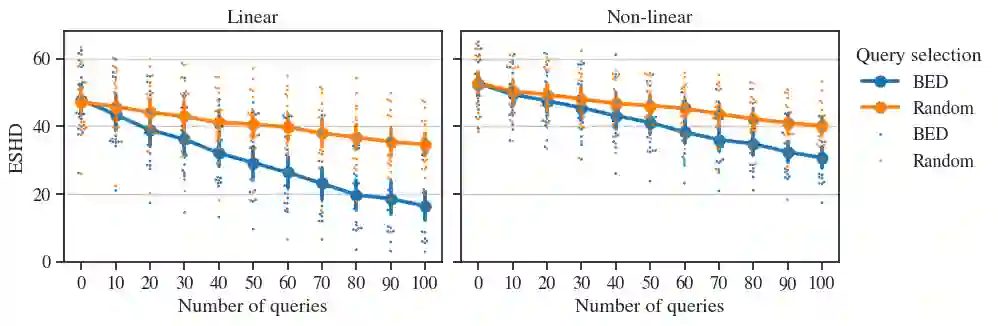
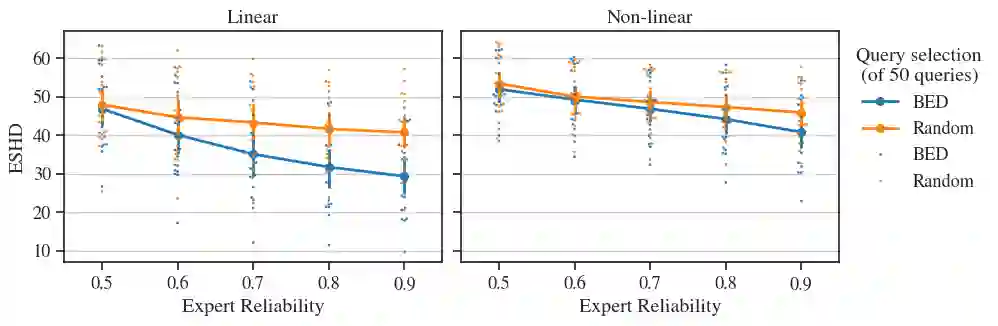
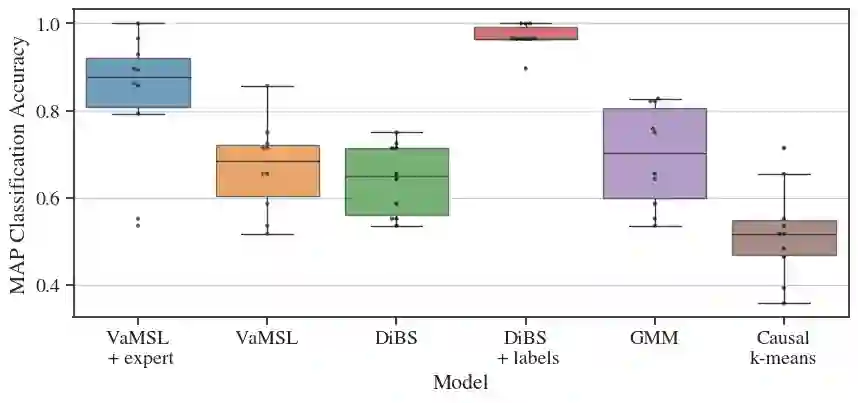
Bayesian causal discovery benefits from prior information elicited from domain experts, and in heterogeneous domains any prior knowledge would be badly needed. However, so far prior elicitation approaches have assumed a single causal graph and hence are not suited to heterogeneous domains. We propose a causal elicitation strategy for heterogeneous settings, based on Bayesian experimental design (BED) principles, and a variational mixture structure learning (VaMSL) method -- extending the earlier differentiable Bayesian structure learning (DiBS) method -- to iteratively infer mixtures of causal Bayesian networks (CBNs). We construct an informative graph prior incorporating elicited expert feedback in the inference of mixtures of CBNs. Our proposed method successfully produces a set of alternative causal models (mixture components or clusters), and achieves an improved structure learning performance on heterogeneous synthetic data when informed by a simulated expert. Finally, we demonstrate that our approach is capable of capturing complex distributions in a breast cancer database.
翻译:贝叶斯因果发现受益于从领域专家处获取的先验信息,而在异质领域中,任何先验知识都极为重要。然而,迄今为止的先验信息获取方法均假设存在单一因果图,因此不适用于异质领域。我们提出了一种基于贝叶斯实验设计原则的异质环境因果信息获取策略,以及一种变分混合结构学习方法——该方法扩展了早期的可微分贝叶斯结构学习方法——用于迭代推断因果贝叶斯网络的混合模型。我们构建了一个信息丰富的图先验,将获取的专家反馈融入因果贝叶斯网络混合模型的推断中。我们提出的方法成功生成了一组替代因果模型(混合分量或聚类),并在模拟专家提供信息的情况下,在异质合成数据上实现了改进的结构学习性能。最后,我们证明该方法能够捕捉乳腺癌数据库中的复杂分布。




相关内容





 微信扫码咨询专知VIP会员