

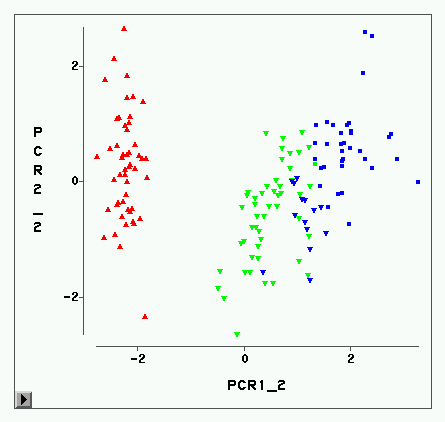
This study challenges the traditional binary view of student progression (retention versus dropout) by conceptualising academic trajectories as complex, quantised pathways. Utilising a 40-year longitudinal dataset from an Argentine engineering faculty (N = 24,016), we introduce CAPIRE, an analytical framework that differentiates between degree major switches, curriculum plan changes, and same-plan re-entries. While 73.3 per cent of students follow linear trajectories (Estables), a significant 26.7 per cent exhibit complex mobility patterns. By applying Principal Component Analysis (PCA) and DBSCAN clustering, we reveal that these trajectories are not continuous but structurally quantised, occupying discrete bands of complexity. The analysis identifies six distinct student archetypes, including 'Switchers' (10.7 per cent) who reorient vocationally, and 'Stable Re-entrants' (6.9 per cent) who exhibit stop-out behaviours without changing discipline. Furthermore, network analysis highlights specific 'hub majors' - such as electronics and computing - that act as systemic attractors. These findings suggest that student flux is an organised ecosystemic feature rather than random noise, offering institutions a new lens for curriculum analytics and predictive modelling.
翻译:暂无翻译




相关内容




 微信扫码咨询专知VIP会员