

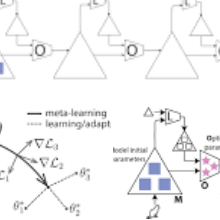
Translating non-invasive signals such as photoplethysmography (PPG) and ballistocardiography (BCG) into clinically meaningful signals like arterial blood pressure (ABP) is vital for continuous, low-cost healthcare monitoring. However, temporal misalignment in multimodal signal transformation impairs transformation accuracy, especially in capturing critical features like ABP peaks. Conventional synchronization methods often rely on strong similarity assumptions or manual tuning, while existing Learning with Noisy Labels (LNL) approaches are ineffective under time-shifted supervision, either discarding excessive data or failing to correct label shifts. To address this challenge, we propose ShiftSyncNet, a meta-learning-based bi-level optimization framework that automatically mitigates performance degradation due to time misalignment. It comprises a transformation network (TransNet) and a time-shift correction network (SyncNet), where SyncNet learns time offsets between training pairs and applies Fourier phase shifts to align supervision signals. Experiments on one real-world industrial dataset and two public datasets show that ShiftSyncNet outperforms strong baselines by 9.4%, 6.0%, and 12.8%, respectively. The results highlight its effectiveness in correcting time shifts, improving label quality, and enhancing transformation accuracy across diverse misalignment scenarios, pointing toward a unified direction for addressing temporal inconsistencies in multimodal physiological transformation.
翻译:将光电容积描记(PPG)和心冲击描记(BCG)等非侵入性信号转换为动脉血压(ABP)等具有临床意义的信号,对于连续、低成本的健康监测至关重要。然而,多模态信号转换中的时间失准会损害转换精度,特别是在捕捉ABP峰值等关键特征时。传统的同步方法通常依赖于强相似性假设或手动调整,而现有的噪声标签学习(LNL)方法在时间偏移监督下效果不佳,要么丢弃过多数据,要么无法校正标签偏移。为应对这一挑战,我们提出了ShiftSyncNet,一种基于元学习的双层优化框架,可自动缓解因时间失准导致的性能下降。该框架包含一个转换网络(TransNet)和一个时间偏移校正网络(SyncNet),其中SyncNet学习训练对之间的时间偏移,并应用傅里叶相移来对齐监督信号。在一个真实工业数据集和两个公共数据集上的实验表明,ShiftSyncNet分别以9.4%、6.0%和12.8%的优势优于强基线方法。结果突显了其在校正时间偏移、提升标签质量以及增强不同失准场景下转换精度方面的有效性,为处理多模态生理转换中的时间不一致性问题指明了统一方向。




相关内容


 微信扫码咨询专知VIP会员