

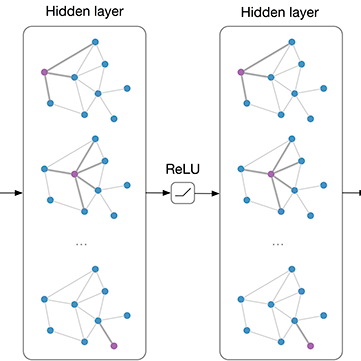
Photonics can offer a hardware-native route for machine learning (ML). However, efficient deployment of photonics-enhanced ML requires hybrid workflows that integrate optical processing with conventional CPU/GPU based neural network architectures. Here, we propose such a workflow that combines photonic positional embeddings (PEs) with advanced graph ML models. We introduce a photonics-based method that augments graph convolutional networks (GCNs) with PEs derived from light propagation on synthetic frequency lattices whose couplings match the input graph. We simulate propagation and readout to obtain internode intensity correlation matrices, which are used as PEs in GCNs to provide global structural information. Evaluated on Long Range Graph Benchmark molecular datasets, the method outperforms baseline GCNs with Laplacian based PEs, achieving $6.3\%$ lower mean absolute error for regression and $2.3\%$ higher average precision for classification tasks using a two-layer GCN as a baseline. When implemented in high repetition rate photonic hardware, correlation measurements can enable fast feature generation by bypassing digital simulation of PEs. Our results show that photonic PEs improve GCN performance and support optical acceleration of graph ML.
翻译:光子学可为机器学习(ML)提供一种硬件原生的实现路径。然而,要高效部署光子增强型机器学习,需要构建混合工作流,将光学处理与基于传统CPU/GPU的神经网络架构相融合。本文提出一种将光子位置编码(PEs)与先进图机器学习模型相结合的工作流程。我们引入一种基于光子学的方法,通过合成频率晶格上的光传播推导出位置编码,并将其增强至图卷积网络(GCNs)中,该晶格的耦合特性与输入图相匹配。我们通过模拟光传播与读出过程获取节点间强度相关矩阵,将其作为位置编码应用于GCNs以提供全局结构信息。在长程图基准分子数据集上的评估表明,该方法优于采用拉普拉斯基位置编码的基线GCNs:使用双层GCN作为基线时,回归任务的平均绝对误差降低6.3%,分类任务的平均精度提升2.3%。若在高重复率光子硬件中实现,相关测量可通过绕过位置编码的数字模拟实现快速特征生成。我们的研究结果表明,光子位置编码能提升GCN性能,并支持图机器学习的光学加速。




相关内容


 微信扫码咨询专知VIP会员