

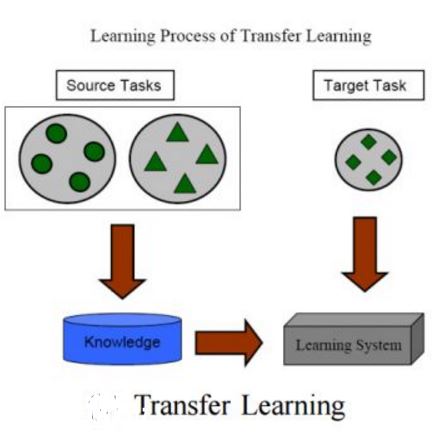
Part qualification is crucial in additive manufacturing (AM) because it ensures that additively manufactured parts can be consistently produced and reliably used in critical applications. Part qualification aims at verifying that an additively manufactured part meets performance requirements; therefore, predicting the complex stress-strain behaviors of additively manufactured parts is critical. We develop a dynamic time warping (DTW)-transfer learning (TL) framework for additive manufacturing part qualification by transferring knowledge of the stress-strain behaviors of additively manufactured low-cost polymers to metals. Specifically, the framework employs DTW to select a polymer dataset as the source domain that is the most relevant to the target metal dataset. Using a long short-term memory (LSTM) model, four source polymers (i.e., Nylon, PLA, CF-ABS, and Resin) and three target metals (i.e., AlSi10Mg, Ti6Al4V, and carbon steel) that are fabricated by different AM techniques are utilized to demonstrate the effectiveness of the DTW-TL framework. Experimental results show that the DTW-TL framework identifies the closest match between polymers and metals to select one single polymer dataset as the source domain. The DTW-TL model achieves the lowest mean absolute percentage error of 12.41% and highest coefficient of determination of 0.96 when three metals are used as the target domain, respectively, outperforming the vanilla LSTM model without TL as well as the TL model pre-trained on four polymer datasets as the source domain.
翻译:部件认证在增材制造中至关重要,因为它确保增材制造部件能够被一致地生产并可靠地应用于关键领域。部件认证旨在验证增材制造部件是否满足性能要求;因此,预测增材制造部件的复杂应力-应变行为是关键。我们开发了一种动态时间规整-迁移学习框架,用于增材制造部件认证,通过将增材制造低成本聚合物的应力-应变行为知识迁移至金属来实现。具体而言,该框架采用动态时间规整来选择与目标金属数据集最相关的聚合物数据集作为源域。使用长短期记忆模型,利用四种源聚合物(即尼龙、聚乳酸、碳纤维增强丙烯腈-丁二烯-苯乙烯和树脂)和三种目标金属(即AlSi10Mg、Ti6Al4V和碳钢),这些材料通过不同的增材制造技术制备,以证明动态时间规整-迁移学习框架的有效性。实验结果表明,动态时间规整-迁移学习框架识别出聚合物与金属之间的最接近匹配,从而选择单个聚合物数据集作为源域。当三种金属用作目标域时,动态时间规整-迁移学习模型分别实现了最低的平均绝对百分比误差12.41%和最高的决定系数0.96,其性能优于未使用迁移学习的原始长短期记忆模型以及以四种聚合物数据集作为源域进行预训练的迁移学习模型。




相关内容


 微信扫码咨询专知VIP会员