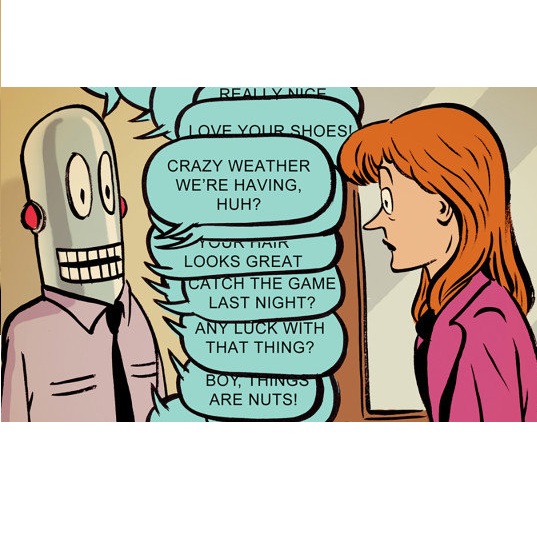
Open-domain chatbots are supposed to converse freely with humans without being restricted to a topic, task or domain. However, the boundaries and/or contents of open-domain conversations are not clear. To clarify the boundaries of "openness", we conduct two studies: First, we classify the types of "speech events" encountered in a chatbot evaluation data set (i.e., Meena by Google) and find that these conversations mainly cover the "small talk" category and exclude the other speech event categories encountered in real life human-human communication. Second, we conduct a small-scale pilot study to generate online conversations covering a wider range of speech event categories between two humans vs. a human and a state-of-the-art chatbot (i.e., Blender by Facebook). A human evaluation of these generated conversations indicates a preference for human-human conversations, since the human-chatbot conversations lack coherence in most speech event categories. Based on these results, we suggest (a) using the term "small talk" instead of "open-domain" for the current chatbots which are not that "open" in terms of conversational abilities yet, and (b) revising the evaluation methods to test the chatbot conversations against other speech events.


翻译:开放式聊天室应该与人自由交谈,而不局限于主题、任务或领域。 但是,开放式对话的界限和(或)内容并不明确。 为了澄清“开放”的界限,我们进行了两项研究: 首先,我们对聊天室评价数据集(即谷歌的Meena)中遇到的“语音事件”的类型进行分类,发现这些对话主要涵盖“小型谈话”类别,并排除在现实生活中人类交流中遇到的其他演讲活动类别。 其次,我们进行小规模试点研究,以产生涵盖两个人与人之间更广泛的言论事件类别的在线对话(即脸书上的Blender)。 对这些对话的人类评估表明,人类对话偏好于人类对话,因为人类聊天室对话在大多数演讲活动类别中缺乏一致性。 基于这些结果,我们建议 (a) 使用“小型对话”一词,而不是“开放式” 来生成当前聊天室和最先进的聊天室对话(即脸书上的Blender) 之间更广泛的言论活动类别, 而不是“公开对话能力 ” 。


0
下载
关闭预览

相关内容

Chatbot,聊天机器人。 chatbot是场交互革命,也是一个多技术融合的平台。上图给出了构建一个chatbot需要具备的组件,简单地说chatbot = NLU(Natural Language Understanding) + NLG(Natural Language Generation)。

知识荟萃

精品入门和进阶教程、论文和代码整理等

更多

查看相关VIP内容、论文、资讯等
不可错过!《机器学习100讲》课程,UBC Mark Schmidt讲授
专知会员服务
76+阅读 · 2022年6月28日
Linux导论,Introduction to Linux,96页ppt
专知会员服务
82+阅读 · 2020年7月26日
强化学习最新教程,17页pdf
专知会员服务
182+阅读 · 2019年10月11日
【SIGGRAPH2019】TensorFlow 2.0深度学习计算机图形学应用
专知会员服务
41+阅读 · 2019年10月9日
VCIP 2022 Call for Special Session Proposals
CCF多媒体专委会
1+阅读 · 2022年4月1日
AIART 2022 Call for Papers
CCF多媒体专委会
1+阅读 · 2022年2月13日
【ICIG2021】Check out the hot new trailer of ICIG2021 Symposium8
中国图象图形学学会CSIG
0+阅读 · 2021年11月16日
【ICIG2021】Check out the hot new trailer of ICIG2021 Symposium4
中国图象图形学学会CSIG
0+阅读 · 2021年11月10日
Transferring Knowledge across Learning Processes
CreateAMind
29+阅读 · 2019年5月18日
国家自然科学基金
0+阅读 · 2013年12月31日
国家自然科学基金
0+阅读 · 2013年12月31日
国家自然科学基金
0+阅读 · 2012年12月31日
国家自然科学基金
0+阅读 · 2011年12月31日
国家自然科学基金
0+阅读 · 2011年12月31日
Arxiv
0+阅读 · 2023年1月26日
Arxiv
19+阅读 · 2018年5月17日
VIP会员
相关VIP内容
不可错过!《机器学习100讲》课程,UBC Mark Schmidt讲授
专知会员服务
76+阅读 · 2022年6月28日
Linux导论,Introduction to Linux,96页ppt
专知会员服务
82+阅读 · 2020年7月26日
强化学习最新教程,17页pdf
专知会员服务
182+阅读 · 2019年10月11日
【SIGGRAPH2019】TensorFlow 2.0深度学习计算机图形学应用
专知会员服务
41+阅读 · 2019年10月9日
相关资讯
VCIP 2022 Call for Special Session Proposals
CCF多媒体专委会
1+阅读 · 2022年4月1日
AIART 2022 Call for Papers
CCF多媒体专委会
1+阅读 · 2022年2月13日
【ICIG2021】Check out the hot new trailer of ICIG2021 Symposium8
中国图象图形学学会CSIG
0+阅读 · 2021年11月16日
【ICIG2021】Check out the hot new trailer of ICIG2021 Symposium4
中国图象图形学学会CSIG
0+阅读 · 2021年11月10日
Transferring Knowledge across Learning Processes
CreateAMind
29+阅读 · 2019年5月18日
相关基金
国家自然科学基金
0+阅读 · 2013年12月31日
国家自然科学基金
0+阅读 · 2013年12月31日
国家自然科学基金
0+阅读 · 2012年12月31日
国家自然科学基金
0+阅读 · 2011年12月31日
国家自然科学基金
0+阅读 · 2011年12月31日
Top
微信扫码咨询专知VIP会员