

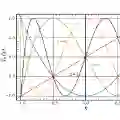
We introduce cumulative polynomial Kolmogorov-Arnold networks (CP-KAN), a neural architecture combining Chebyshev polynomial basis functions and quadratic unconstrained binary optimization (QUBO). Our primary contribution involves reformulating the degree selection problem as a QUBO task, reducing the complexity from $O(D^N)$ to a single optimization step per layer. This approach enables efficient degree selection across neurons while maintaining computational tractability. The architecture performs well in regression tasks with limited data, showing good robustness to input scales and natural regularization properties from its polynomial basis. Additionally, theoretical analysis establishes connections between CP-KAN's performance and properties of financial time series. Our empirical validation across multiple domains demonstrates competitive performance compared to several traditional architectures tested, especially in scenarios where data efficiency and numerical stability are important. Our implementation, including strategies for managing computational overhead in larger networks is available in Ref.~\citep{cpkan_implementation}.
翻译:本文提出累积多项式Kolmogorov-Arnold网络(CP-KAN),这是一种结合切比雪夫多项式基函数与二次无约束二进制优化(QUBO)的神经网络架构。我们的主要贡献在于将多项式次数选择问题重新表述为QUBO任务,从而将复杂度从$O(D^N)$降低至每层仅需一次优化步骤。该方法能够在保持计算可处理性的同时,高效地实现跨神经元的多项式次数选择。该架构在有限数据回归任务中表现良好,对输入尺度具有良好的鲁棒性,并因其多项式基函数而具备天然的正则化特性。此外,理论分析建立了CP-KAN性能与金融时间序列特性之间的联系。我们在多个领域的实证验证表明,相较于测试的若干传统架构,CP-KAN展现出具有竞争力的性能,尤其在数据效率和数值稳定性至关重要的场景中。我们的实现方案(包括管理大型网络计算开销的策略)已在文献\citep{cpkan_implementation}中公开。




相关内容



 微信扫码咨询专知VIP会员