

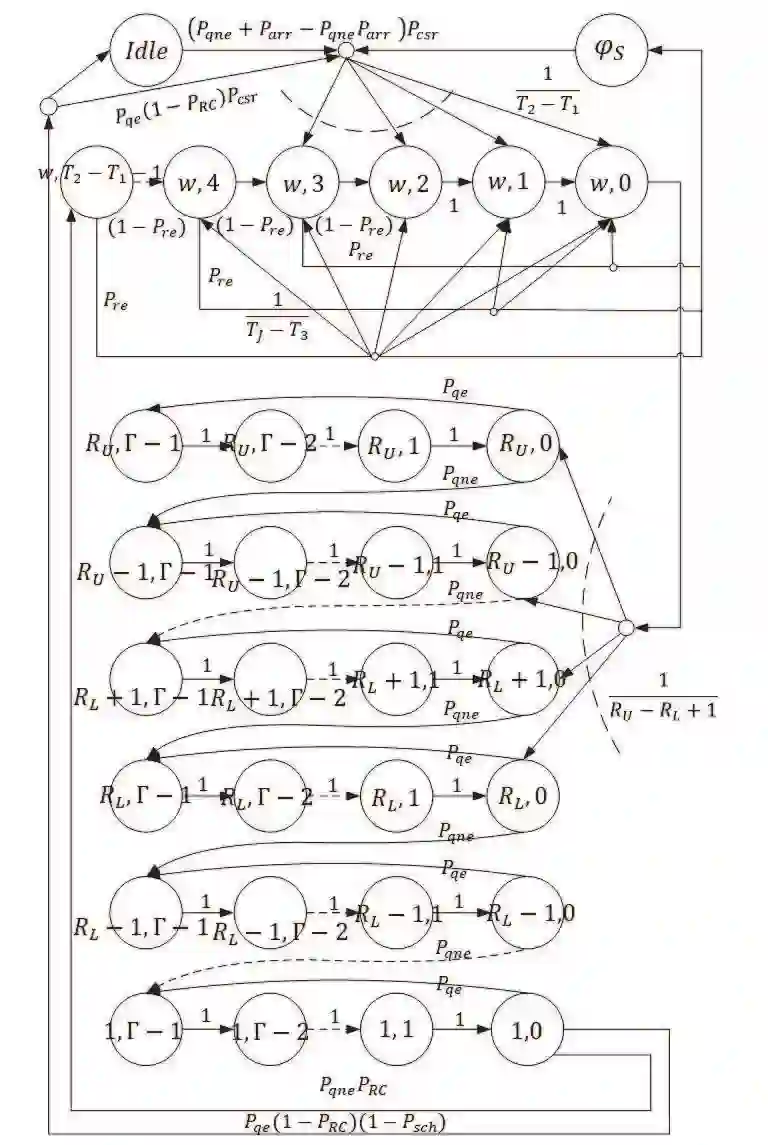
Massive message transmissions, unpredictable aperiodic messages, and high-speed moving vehicles contribute to the complex wireless environment, resulting in inefficient resource collisions in Vehicle to Everything (V2X). In order to achieve better medium access control (MAC) layer performance, 3GPP introduced several new features in NR-V2X. One of the most important is the re-evaluation mechanism. It allows the vehicle to continuously sense resources before message transmission to avoid resource collisions. So far, only a few articles have studied the re-evaluation mechanism of NR-V2X, and they mainly focus on network simulator that do not consider variable traffic, which makes analysis and comparison difficult. In this paper, an analytical model of NR-V2X Mode 2 is established, and a message generator is constructed by using discrete time Markov chain (DTMC) to simulate the traffic pattern recommended by 3GPP advanced V2X services. Our study shows that the re-evaluation mechanism improves the reliability of NR-V2X transmission, but there are still local improvements needed to reduce latency.
翻译:大规模消息传输、不可预测的非周期性消息以及高速移动的车辆共同构成了复杂的无线环境,导致车联网(V2X)中资源碰撞效率低下。为提升介质访问控制(MAC)层性能,3GPP在NR-V2X中引入了多项新特性,其中重评估机制最为关键。该机制允许车辆在消息传输前持续感知资源,从而避免资源碰撞。目前仅有少数文献研究NR-V2X的重评估机制,且主要基于未考虑可变流量的网络模拟器,导致分析与比较存在困难。本文建立了NR-V2X模式2的分析模型,并采用离散时间马尔可夫链(DTMC)构建消息生成器,以模拟3GPP高级V2X服务推荐的流量模式。研究表明,重评估机制提升了NR-V2X传输的可靠性,但在降低延迟方面仍需局部改进。




相关内容




 微信扫码咨询专知VIP会员