

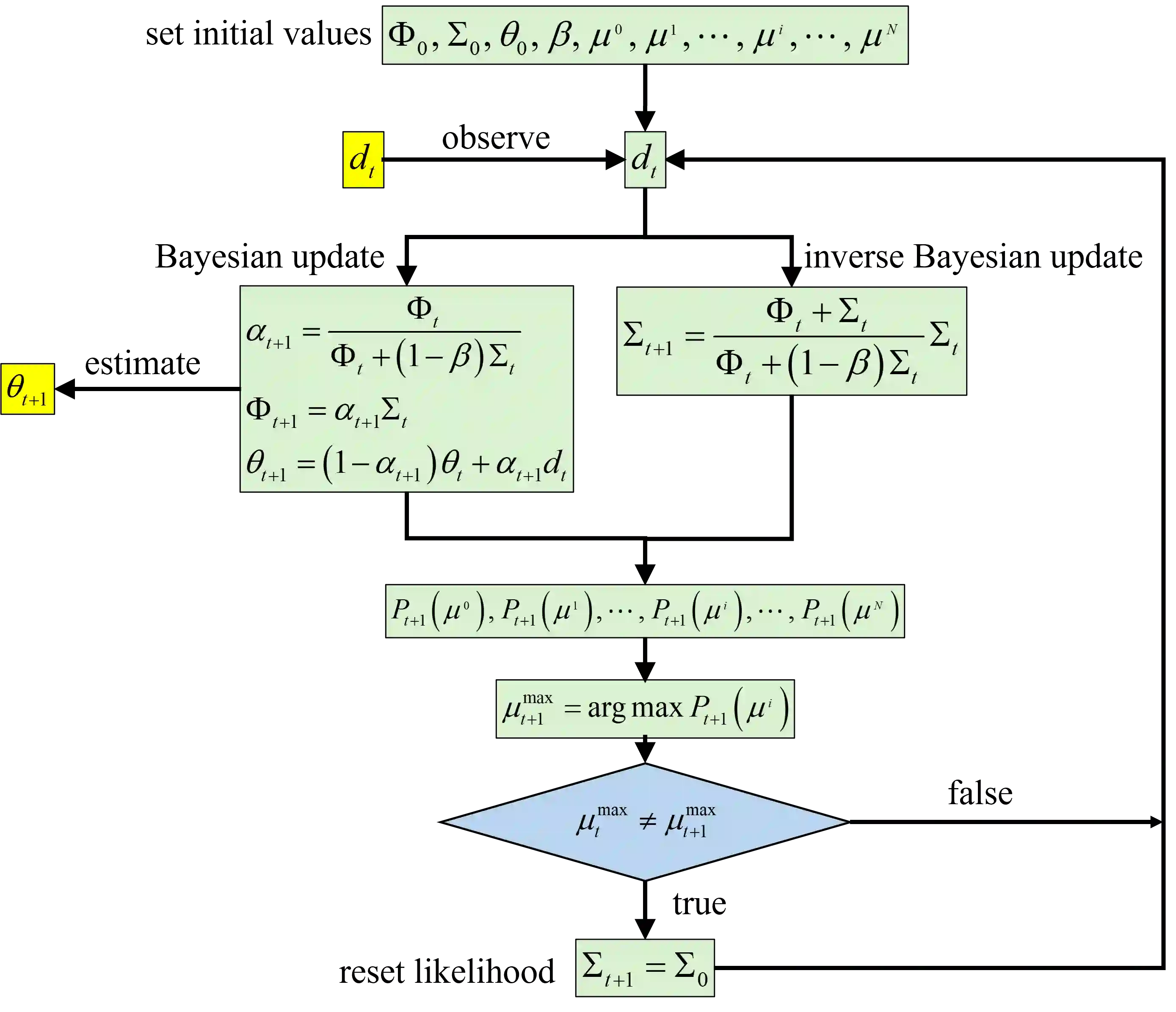
This study proposes the novel Bayesian and inverse Bayesian (BIB) inference framework that incorporates symmetry bias into the Bayesian updating process to perform both conventional and inverse Bayesian updates concurrently. Conventional Bayesian inference is constrained by a fundamental trade-off between adaptability to abrupt environmental changes and accuracy during stable periods. The BIB framework addresses this limitation by dynamically modulating the learning rate via inverse Bayesian updates, thereby enhancing adaptive flexibility. The BIB model was evaluated in a sequential estimation task involving observations drawn from a Gaussian distribution with a stochastically time-varying mean, where it exhibited spontaneous bursts in the learning rate during environmental transitions, transiently entering high-sensitivity states that facilitated rapid adaptation. This burst-relaxation dynamic serves as a mechanism for balancing adaptability and accuracy. Furthermore, avalanche analysis, detrended fluctuation analysis, and power spectral analysis revealed that the BIB system likely operates near a critical state-a property not observed in standard Bayesian inference. This suggests that the BIB model uniquely achieves a coexistence of computational efficiency and critical dynamics, resolving the adaptability-accuracy trade-off while maintaining scale-free behavior. These findings offer a new computational perspective on scale-free dynamics in natural systems and provide valuable insights for the design of adaptive inference systems in nonstationary environments.
翻译:本研究提出了一种新颖的贝叶斯与逆贝叶斯推理框架,该框架将对称性偏置融入贝叶斯更新过程,以同时执行常规贝叶斯更新和逆贝叶斯更新。传统贝叶斯推理受限于对突发环境变化的适应性与稳定期准确性之间的基本权衡。BIB框架通过逆贝叶斯更新动态调节学习率,从而增强自适应灵活性,解决了这一局限。BIB模型在涉及从具有随机时变均值的高斯分布中抽取观测值的序列估计任务中进行了评估,结果显示其在环境转换期间学习率会自发爆发,短暂进入高敏感状态,从而促进快速适应。这种爆发-松弛动力学机制实现了适应性与准确性之间的平衡。此外,雪崩分析、去趋势波动分析和功率谱分析表明,BIB系统很可能在临界状态附近运行——这一特性在标准贝叶斯推理中未被观察到。这表明BIB模型独特地实现了计算效率与临界动力学的共存,在保持无标度行为的同时解决了适应性-准确性权衡问题。这些发现为自然系统中无标度动力学提供了新的计算视角,并为非平稳环境下自适应推理系统的设计提供了重要见解。




相关内容



 微信扫码咨询专知VIP会员