

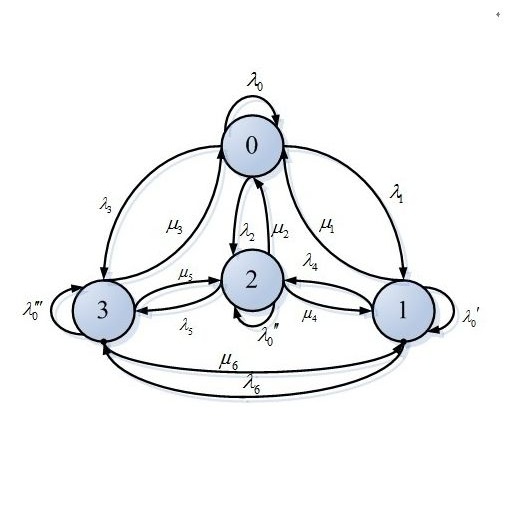
We show that nonequilibrium dynamics can play a constructive role in unsupervised machine learning by inducing the spontaneous emergence of latent-state cycles. We introduce a model in which visible and hidden variables interact through two independently parametrized transition matrices, defining a Markov chain whose steady state is intrinsically out of equilibrium. Likelihood maximization drives this system toward nonequilibrium steady states with finite entropy production, reduced self-transition probabilities, and persistent probability currents in the latent space. These cycles are not imposed by the architecture but arise from training, and models that develop them avoid the low-log-likelihood regime associated with nearly reversible dynamics while more faithfully reproducing the empirical distribution of data classes. Compared with equilibrium approaches such as restricted Boltzmann machines, our model breaks the detailed balance between the forward and backward conditional transitions and relies on a log-likelihood gradient that depends explicitly on the last two steps of the Markov chain. Hence, this exploration of the interface between nonequilibrium statistical physics and modern machine learning suggests that introducing irreversibility into latent-variable models can enhance generative performance.
翻译:我们证明,非平衡动力学在无监督机器学习中可发挥建设性作用,通过诱导潜在状态循环的自发涌现。我们引入一个模型,其中可见变量和隐藏变量通过两个独立参数化的转移矩阵相互作用,定义了一个稳态本质上处于非平衡状态的马尔可夫链。似然最大化驱动该系统趋向具有有限熵产生、降低的自转移概率以及潜在空间中持续概率流的非平衡稳态。这些循环并非由架构强加,而是从训练中产生,且发展出这些循环的模型避免了与近乎可逆动力学相关的低对数似然区域,同时更忠实地复现了数据类别的经验分布。与受限玻尔兹曼机等平衡方法相比,我们的模型打破了前向与后向条件转移之间的细致平衡,并依赖于一个明确依赖于马尔可夫链最后两步的对数似然梯度。因此,这一对非平衡统计物理学与现代机器学习界面的探索表明,将不可逆性引入潜在变量模型可以提升生成性能。




相关内容


 微信扫码咨询专知VIP会员