

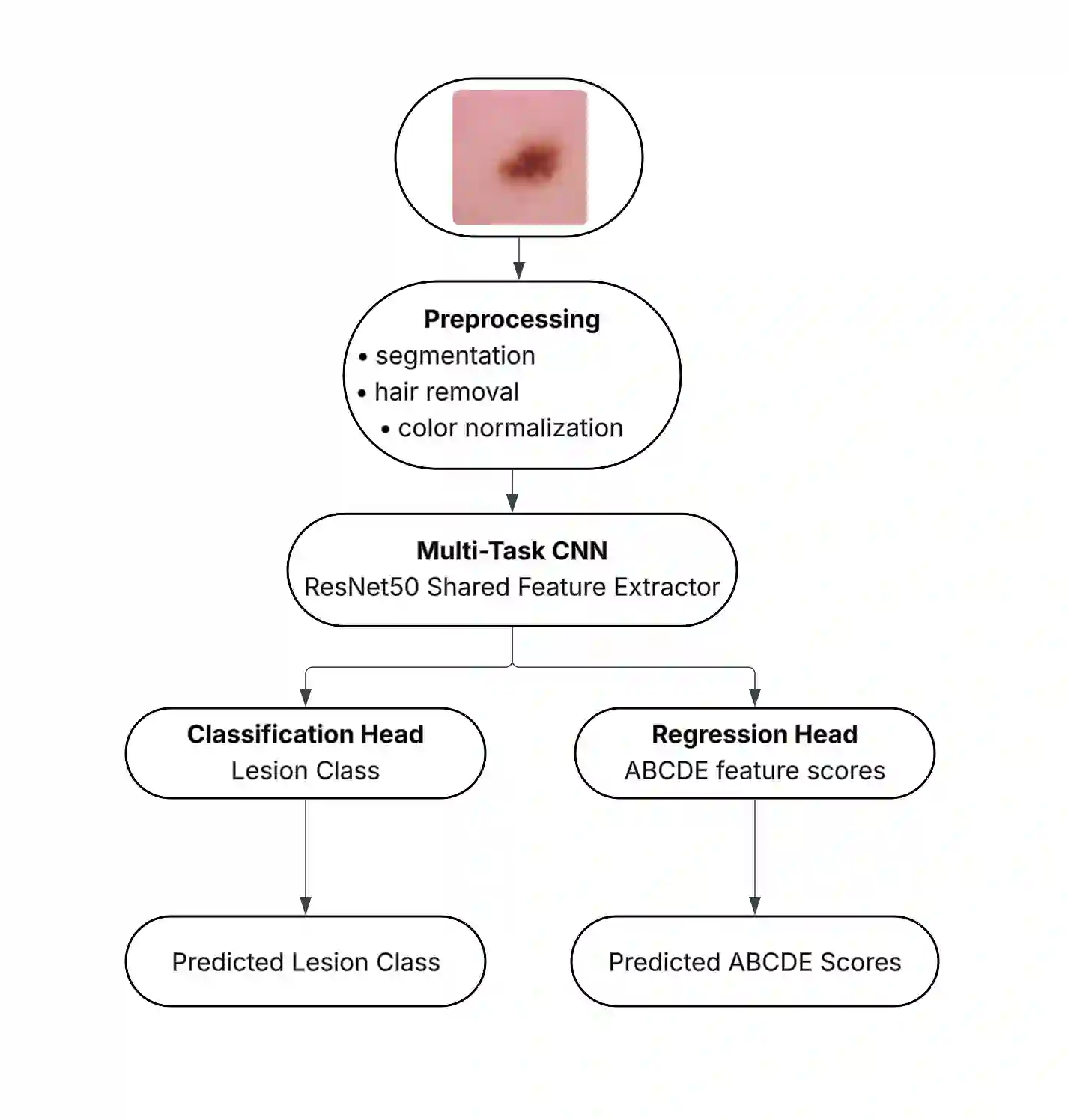
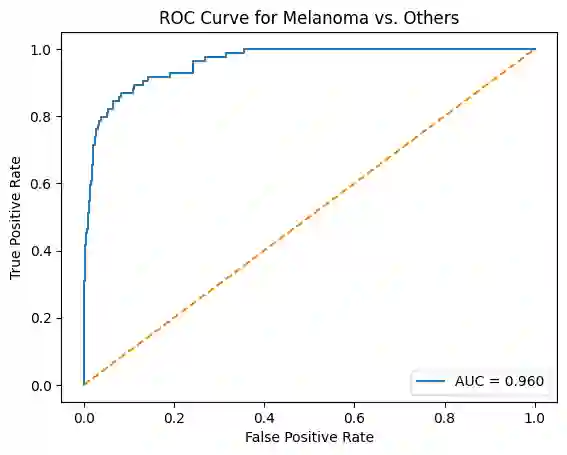
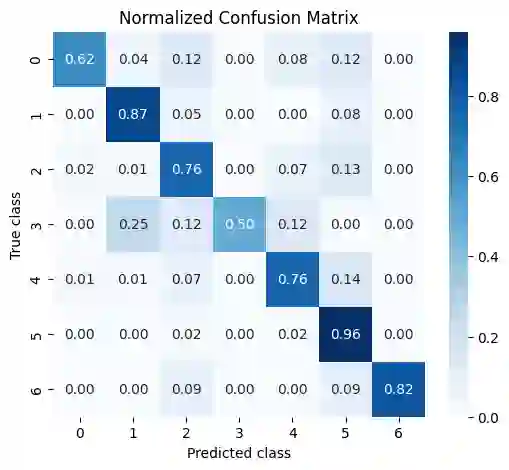
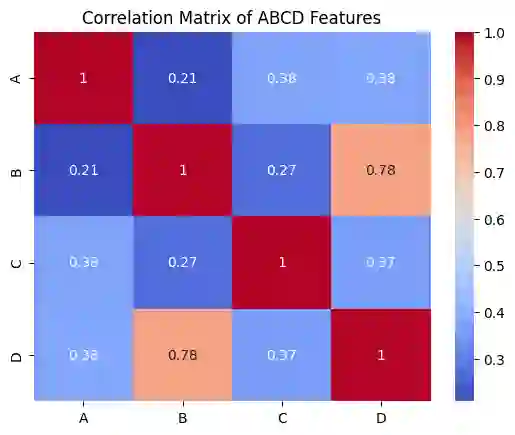
Early detection of melanoma has grown to be essential because it significantly improves survival rates, but automated analysis of skin lesions still remains challenging. ABCDE, which stands for Asymmetry, Border irregularity, Color variation, Diameter, and Evolving, is a well-known classification method for skin lesions, but most deep learning mechanisms treat it as a black box, as most of the human interpretable features are not explained. In this work, we propose a deep learning framework that both classifies skin lesions into categories and also quantifies scores for each ABCD feature. It simulates the evolution of these features over time in order to represent the E aspect, opening more windows for future exploration. The A, B, C, and D values are quantified particularly within this work. Moreover, this framework also visualizes ABCD feature trajectories in latent space as skin lesions evolve from benign nevuses to malignant melanoma. The experiments are conducted using the HAM10000 dataset that contains around ten thousand images of skin lesions of varying stages. In summary, the classification worked with an accuracy of around 89 percent, with melanoma AUC being 0.96, while the feature evaluation performed well in predicting asymmetry, color variation, and diameter, though border irregularity remains more difficult to model. Overall, this work provides a deep learning framework that will allow doctors to link ML diagnoses to clinically relevant criteria, thus improving our understanding of skin cancer progression.
翻译:早期检测黑色素瘤已变得至关重要,因为它能显著提高生存率,但皮肤病变的自动化分析仍面临挑战。ABCDE(代表不对称性、边界不规则性、颜色变化、直径和演变)是一种广为人知的皮肤病变分类方法,但大多数深度学习机制将其视为黑箱,因为其中可解释的人类特征大多未被阐明。本研究提出一种深度学习框架,既能将皮肤病变分类为不同类别,也能量化每个ABCD特征的评分。该框架通过模拟这些特征随时间演变的过程来表征E维度,为未来探索开辟更多窗口。本研究特别对A、B、C、D值进行了量化。此外,该框架还能在潜在空间中可视化ABCD特征轨迹,呈现皮肤病变从良性痣演变为恶性黑色素瘤的过程。实验使用HAM10000数据集进行,该数据集包含约一万张不同阶段皮肤病变图像。总体而言,分类准确率约为89%,黑色素瘤的AUC达到0.96;特征评估在预测不对称性、颜色变化和直径方面表现良好,但边界不规则性的建模仍较为困难。本工作提供的深度学习框架将使医生能够将机器学习诊断与临床相关标准联系起来,从而增进我们对皮肤癌进展的理解。





相关内容





 微信扫码咨询专知VIP会员