

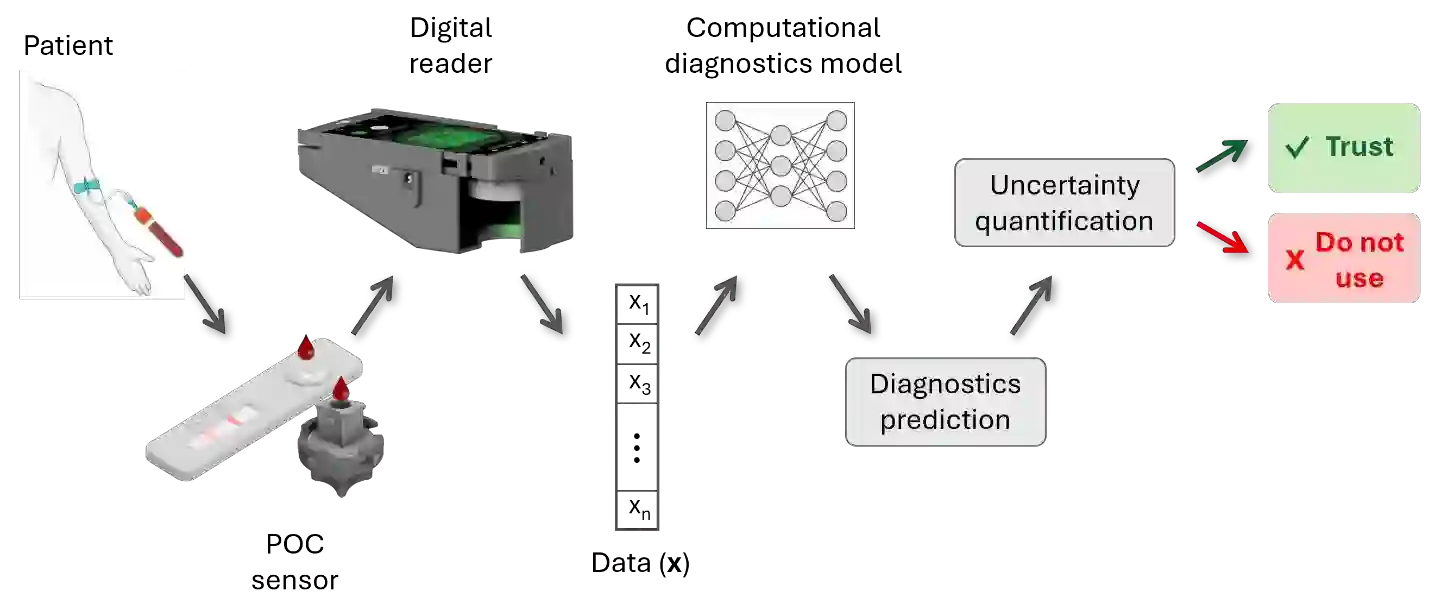
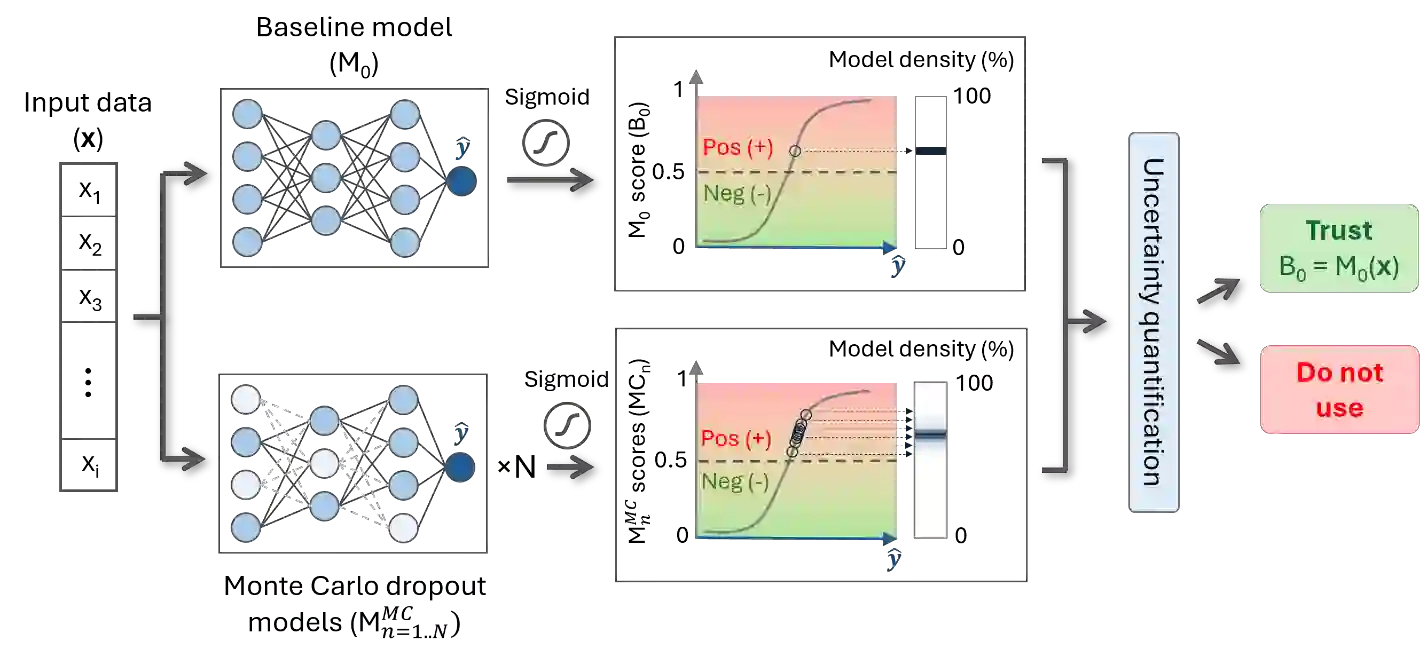
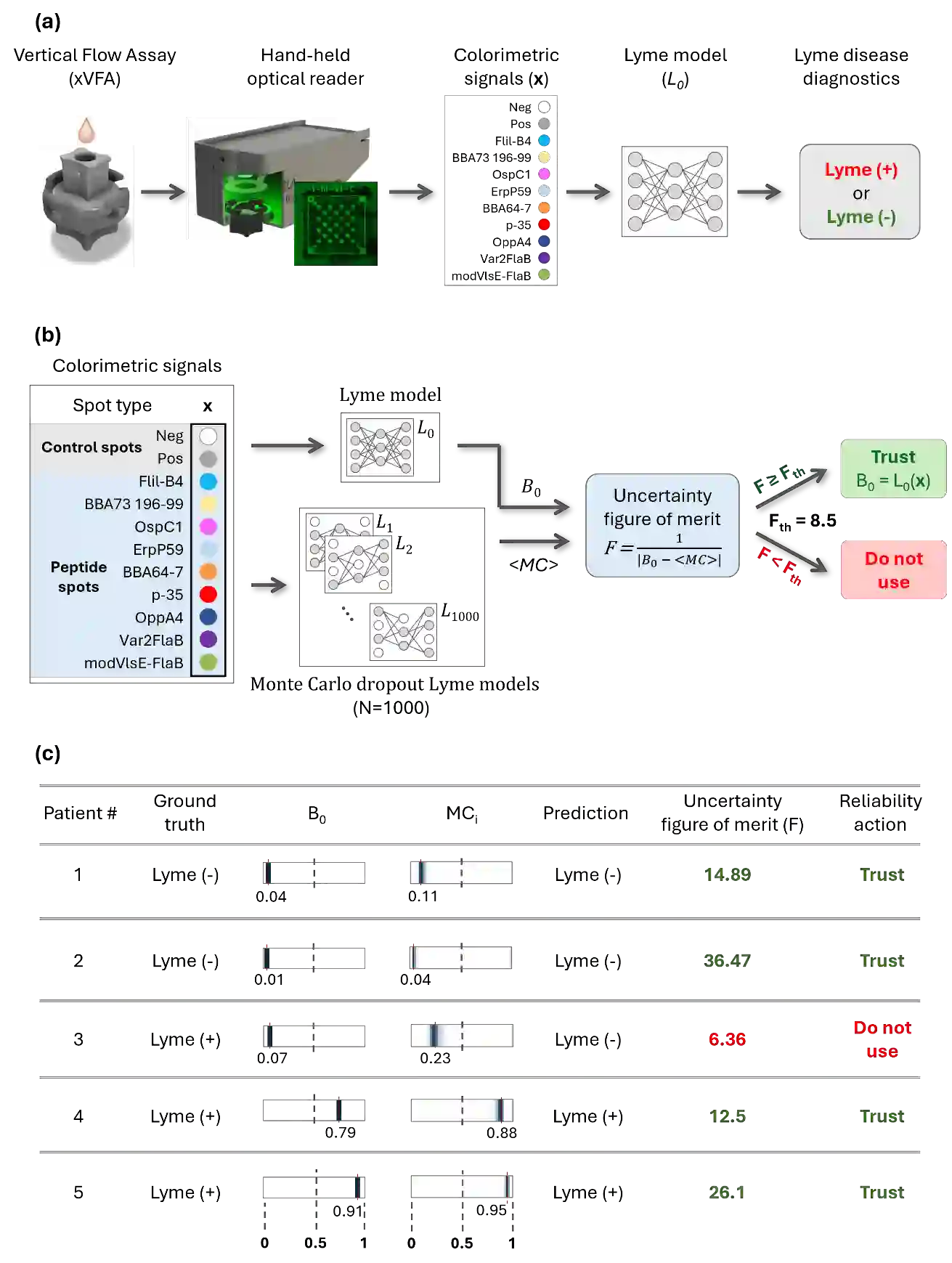
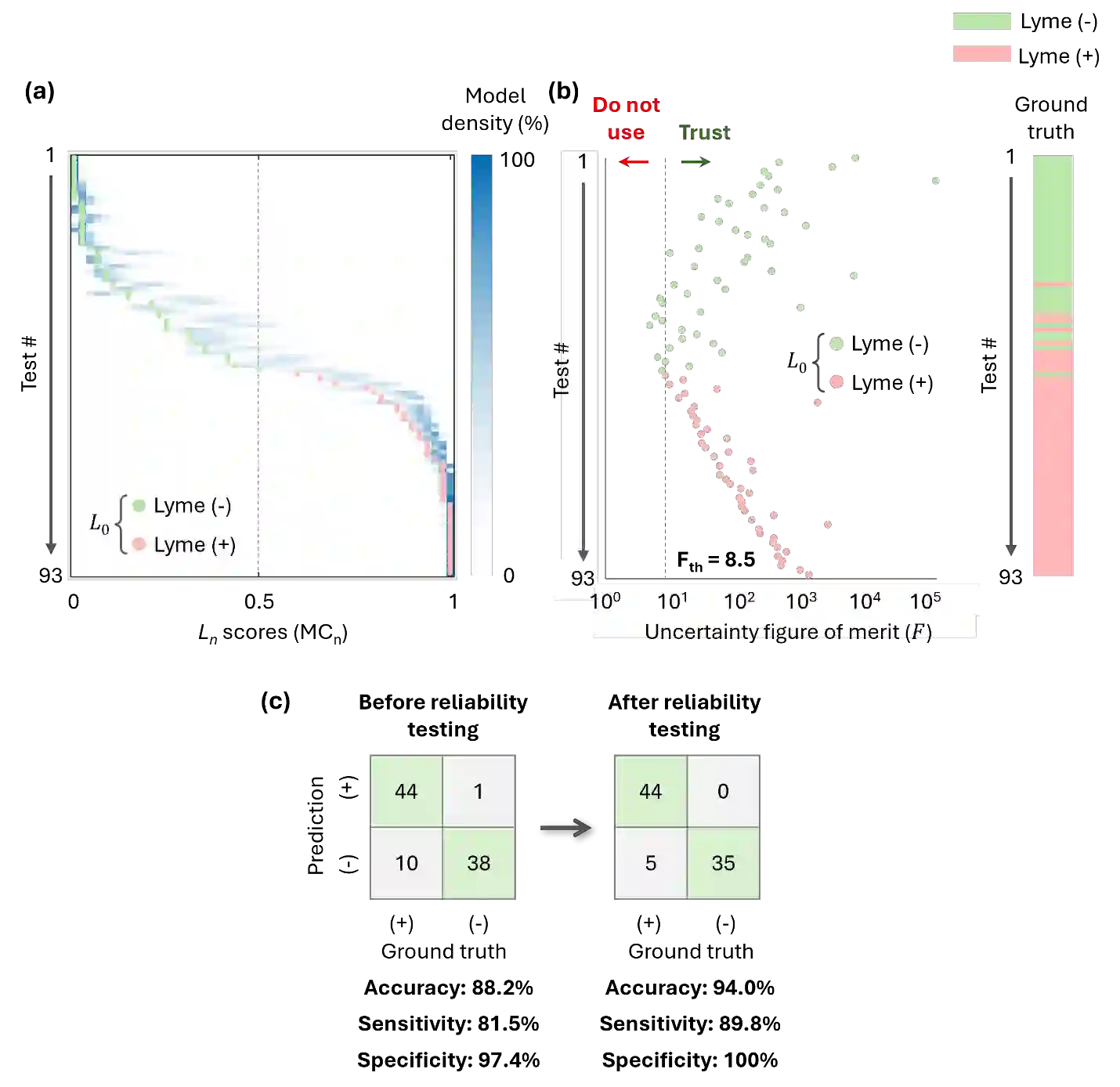
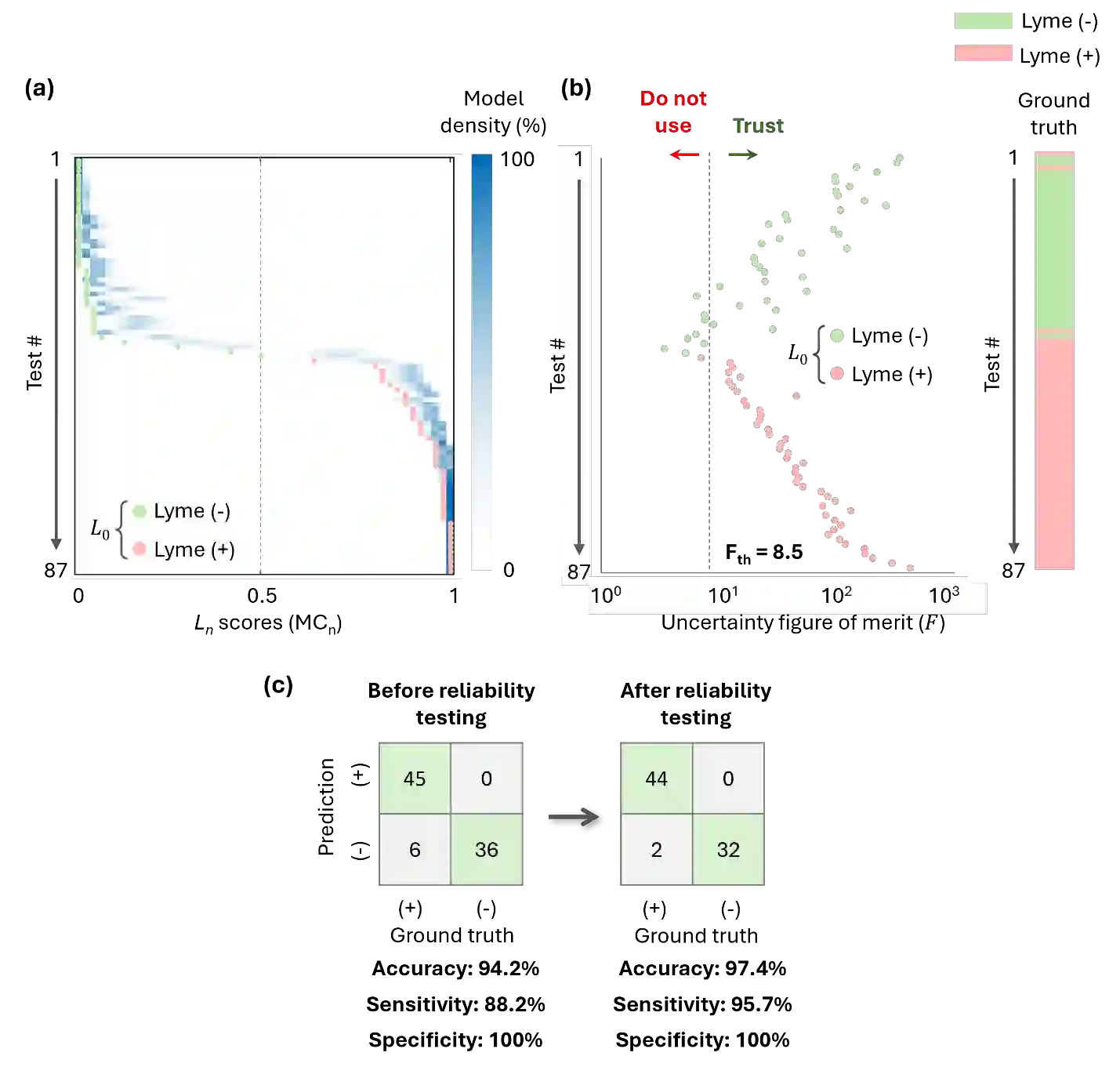
Computational point-of-care (POC) sensors enable rapid, low-cost, and accessible diagnostics in emergency, remote and resource-limited areas that lack access to centralized medical facilities. These systems can utilize neural network-based algorithms to accurately infer a diagnosis from the signals generated by rapid diagnostic tests or sensors. However, neural network-based diagnostic models are subject to hallucinations and can produce erroneous predictions, posing a risk of misdiagnosis and inaccurate clinical decisions. To address this challenge, here we present an autonomous uncertainty quantification technique developed for POC diagnostics. As our testbed, we used a paper-based, computational vertical flow assay (xVFA) platform developed for rapid POC diagnosis of Lyme disease, the most prevalent tick-borne disease globally. The xVFA platform integrates a disposable paper-based assay, a handheld optical reader and a neural network-based inference algorithm, providing rapid and cost-effective Lyme disease diagnostics in under 20 min using only 20 uL of patient serum. By incorporating a Monte Carlo dropout (MCDO)-based uncertainty quantification approach into the diagnostics pipeline, we identified and excluded erroneous predictions with high uncertainty, significantly improving the sensitivity and reliability of the xVFA in an autonomous manner, without access to the ground truth diagnostic information of patients. Blinded testing using new patient samples demonstrated an increase in diagnostic sensitivity from 88.2% to 95.7%, indicating the effectiveness of MCDO-based uncertainty quantification in enhancing the robustness of neural network-driven computational POC sensing systems.
翻译:计算床旁(POC)传感器能够在缺乏中心医疗设施的紧急、偏远和资源有限地区实现快速、低成本且可及的诊断。这些系统可利用基于神经网络的算法,从快速诊断测试或传感器产生的信号中准确推断诊断结果。然而,基于神经网络的诊断模型容易出现幻觉并可能产生错误预测,从而导致误诊和不准确临床决策的风险。为应对这一挑战,本文提出一种为POC诊断开发的自主不确定性量化技术。作为测试平台,我们使用了一种基于纸张的计算式垂直流检测(xVFA)平台,该平台专为莱姆病(全球最常见的蜱传疾病)的快速POC诊断而开发。xVFA平台集成了一次性纸基检测装置、手持式光学阅读器和基于神经网络的推理算法,仅需20微升患者血清即可在20分钟内提供快速且经济高效的莱姆病诊断。通过将基于蒙特卡洛丢弃法(MCDO)的不确定性量化方法整合到诊断流程中,我们能够识别并排除具有高不确定性的错误预测,从而在无需获取患者真实诊断信息的情况下,以自主方式显著提升xVFA的灵敏度和可靠性。使用新患者样本进行的盲法测试表明,诊断灵敏度从88.2%提高至95.7%,这证明了基于MCDO的不确定性量化在增强神经网络驱动的计算POC传感系统鲁棒性方面的有效性。




相关内容


 微信扫码咨询专知VIP会员